

1. ABS Overview
ABS is one of the most widely used materials across various industries. A stands for Acrylonitrile, B for Butadiene, and S for Styrene. Due to its composite nature, it exhibits diverse properties and melting temperatures. When blended with other plastics or additives, ABS can be expanded into various grades with different applications and performances, such as impact-resistant, heat-resistant, flame-retardant, transparent, reinforced, and electroplating grades. Its flowability falls between that of PS and PC, and is influenced by both injection temperature and pressure—with injection pressure having a slightly greater impact. Therefore, a higher injection pressure is often utilized during molding to reduce melt viscosity and improve mold-filling performance.
ABS Injection Molding Properties
General ABS has a melting point of around 170°C and a decomposition temperature of 260°C, offering a relatively wide adjustable range for injection temperature. During injection molding, the processing temperature generally ranges from 180°C to 240°C. Due to the presence of the rubber component, it absorbs a small amount of moisture and must be dried before production, typically at 80–90°C for 1–2 hours. Meanwhile, this rubber component also results in poor thermal stability, making the material prone to decomposition; thus, the raw material should not stay in the barrel for too long during molding. Its melt viscosity is higher than that of PS, but with conventional gates and runners, it can still fill the product fully. The molded parts are prone to static electricity and easily attract dust to the surface. The shrinkage rate is 0.5% (5‰), and the flash threshold is 0.05 mm.
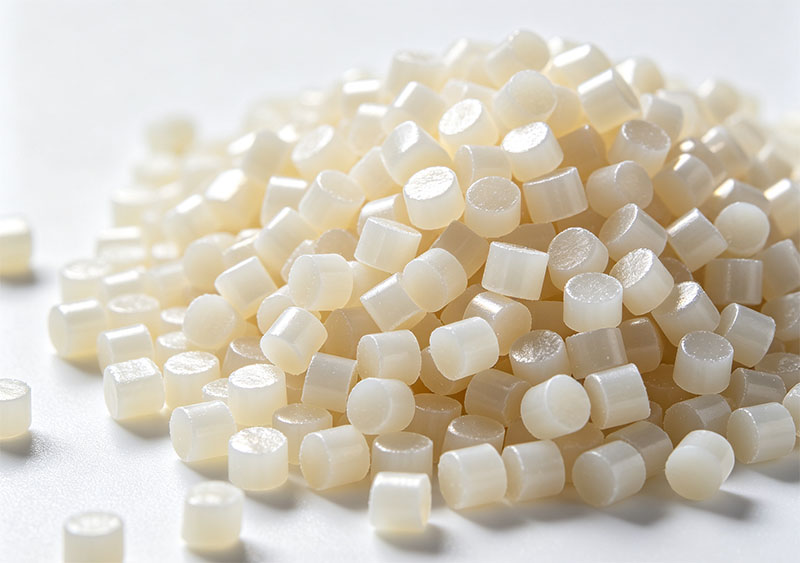
2. PC Overview
PC (Polycarbonate) possesses excellent performance and high transparency, but features high viscosity, a high melt temperature, and poor flowability. Consequently, it must be injected at higher temperatures (270–320°C). Relatively speaking, its temperature adjustment range is narrow, making its processability inferior to that of PMMA. Injection pressure has a minor effect on its flowability; however, due to its high viscosity, a large injection pressure is still required. Correspondingly, to prevent internal stress, the holding time should be kept as short as possible. PC exhibits a large shrinkage rate and high internal stress, making it prone to cracking. Therefore, it is advisable to improve flowability by increasing the temperature rather than the pressure. Potential cracking should be mitigated by raising the mold temperature, optimizing the mold structure, and implementing post-treatment. When the injection speed is low, defects like ripples are likely to occur at the gate. The nozzle temperature needs to be controlled independently, the mold temperature must be high, and the resistance in runners and gates should be minimal.
PC Injection Molding Properties
PC is an amorphous plastic without a distinct melting point, and its typical processing temperature is 250–320°C. It is hygroscopic (absorbs water), and even a small amount of moisture can cause decomposition at high temperatures; thus, thorough drying is mandatory before injection molding. The melt viscosity of PC is high, requiring substantial pressure during injection. During processing, if conditions permit, a mold temperature controller can be used to raise the mold temperature to reduce residual stress in the product. For products with inserts, if the insert diameter is less than 1–2 mm, preheating can be omitted; larger inserts must be preheated, otherwise, stress cracking will occur. The shrinkage rate of PC is independent of processing conditions and product wall thickness, and its longitudinal and transverse shrinkage rates are quite close, allowing it to be processed into high-precision products.
3. PVC Overview
PVC stands for Polyvinyl Chloride. Commonly used PVC compounds are in granular form. It is a multi-component plastic; in addition to the previously mentioned PVC resin powder, plasticizers must be added to increase flowability, stabilizers to improve thermal stability, lubricants to enhance mold release, along with fillers, colorants, and coupling agents. Due to the varying content of each component, PVC granules are formed with vastly different mechanical properties and hardness levels, usually represented by IP degrees. PVC granules are generally categorized into flexible (soft) PVC and rigid PVC.
PVC Injection Molding Properties
PVC raw materials absorb moisture slightly and must be dried during production. PVC has no distinct melting point and easily releases toxic gases during the molding process; therefore, a large amount of heat stabilizers must be added for injection molding. The material should be injected at the lowest possible temperature while minimizing the molding cycle to reduce the residence time of the melt in the barrel. Prolonged heating inside the barrel will cause the compound to turn yellow or even produce black spots. Furthermore, hydrogen chloride (HCl) has a corrosive effect on the mold cavity, so the mold cavity and any dead corners in the machine head must be cleaned frequently. The mold temperature should be kept as low as possible to shorten the molding cycle and minimize the size of the molded parts. The gates and runners of the mold should be as thick, short, and wide as possible to reduce pressure loss and enable the material flow to fill the cavity quickly. A combination of high pressure and low temperature is preferred.
4. PA Overview
PA is the general term for polyamide plastics, also commonly known as Nylon. They all contain amide groups in their chemical structure and share similar performance characteristics. Their general appearance features are that they are a class of tough, horn-like materials ranging from yellowish-transparent to opaque. Standard nylon is a crystalline plastic, though amorphous transparent nylons also exist. It is widely used to manufacture spare parts such as bearings, gears, wheels, and rollers in plastic products.
PA Injection Molding Properties
Due to the presence of amide groups, PA exhibits strong and tight moisture absorption; therefore, it must be thoroughly dried before injection molding. PA has low viscosity and a fast flow speed. To prevent nozzle drooling, a self-locking nozzle or a specialized nylon nozzle should be used. At the same time, close attention must be paid to mold precision.
5. PMMA Overview
The chemical name of PMMA is Polymethyl Methacrylate, commonly known as plexiglass or acrylic. PMMA consists of colorless, transparent granules with a relative density of 1.19, making it heavier than water. It features high surface gloss, and the resulting products are characterized by toughness, hardness, and rigidity.
PMMA Injection Molding Properties
PMMA has high viscosity and slightly poor flowability, requiring high material temperatures and high injection pressures for molding. The injection temperature has a greater impact than the injection pressure, though increasing the injection pressure helps improve product shrinkage. It has a wide injection temperature range and good processability; hence, efforts to improve flowability can start with adjusting the injection temperature. It has poor impact strength, low wear resistance, is easily scratched, and is prone to brittle cracking. Therefore, the mold temperature should be increased to optimize the cooling process and overcome these defects. PMMA is an amorphous polymer with no distinct melting point, offering a relatively wide adjustable range for injection temperature.
6. PS Overview
PS plastic (Polystyrene) material performance: It features excellent electrical insulation (especially high-frequency insulation), is colorless and transparent, and its light transmittance is second only to plexiglass. It offers good colorability, water resistance, and chemical stability. Its strength is average, but it is brittle, prone to stress cracking, and not resistant to organic solvents such as benzene and gasoline. It is suitable for making insulating transparent parts, decorative pieces, chemical instruments, optical instruments, and other components.
PS Injection Molding Properties
Molding Performance:
1. It is an amorphous material with low moisture absorption, requiring no extensive drying, and does not decompose easily. However, it has a large coefficient of thermal expansion and easily generates internal stress. It offers good flowability and can be molded using screw or plunger injection molding machines.
2. It is advisable to use high material temperatures, high mold temperatures, and low injection pressures. Extending the injection time helps reduce internal stress and prevent sink marks or deformation.
3. Various gate types can be used. The gate should connect to the plastic part with a radius/arc to avoid damaging the part when the gate is removed. It requires a large draft angle and uniform ejection. The wall thickness of the plastic part should be uniform, and it is best not to include inserts; if inserts are necessary, they must be preheated.
Post time: Jul-06-2026